Symi: Greece's Most Beautiful Harbour Town
The neoclassical harbour of Symi is one of the most photographed in Greece — but the island rewards those who stay long enough to discover what lies beyond it.
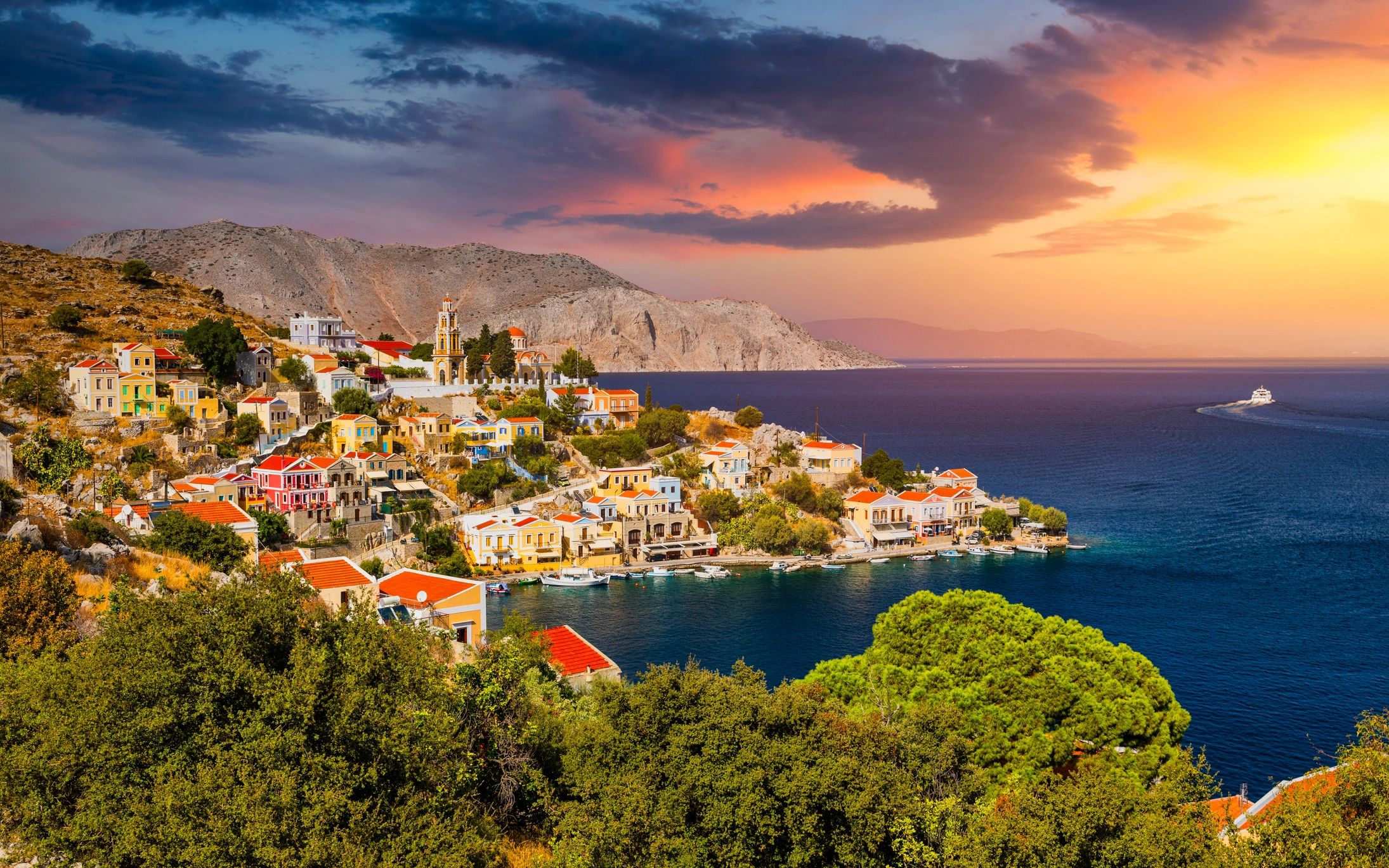
Most people see Symi for the first time from the deck of a ferry or a day-trip boat, and the reaction is always the same: a sharp intake of breath. The harbour town of Gialos rises from the water in tiers of neoclassical mansions — ochre, terracotta, cream, and gold — their facades reflected in the still water of the harbour. It is one of the most beautiful arrivals in Greece.
The tragedy is that most visitors see it only as a day trip from Rhodes. They arrive at 10am, walk the harbour, eat lunch, and leave by 4pm. They miss almost everything.
The Island That Rewards Staying
Symi is small — about 58 square kilometres — but it has a depth that takes time to discover. The day-trippers see the harbour. Those who stay see the rest.
Ano Symi (Upper Symi) sits above Gialos, connected by the Kali Strata — a staircase of 500 steps that climbs through the old town. The upper village is quieter, more residential, and offers views over the harbour that the waterfront restaurants cannot match. In the evening, when the day-trippers have gone, Ano Symi is one of the most peaceful places in the Dodecanese.
Panormitis Monastery occupies a sheltered bay on the southern tip of the island, accessible by boat or by a winding road through the interior. The monastery is dedicated to the Archangel Michael and is one of the most important pilgrimage sites in the Dodecanese. The frescoed interior, the Byzantine museum, and the extraordinary setting make it worth the journey.
The interior villages — Horio, Nimborio, Pedi — are almost entirely free of tourists and offer a glimpse of the island's traditional life. The road through the interior passes through a landscape of pine and maquis, with views that open suddenly onto the sea.
The Architecture
Symi's neoclassical architecture is the result of a remarkable period of prosperity in the 18th and 19th centuries, when the island's sponge-diving industry made it one of the wealthiest in the Aegean. The merchants built mansions that reflected their status — elaborate facades, painted ceilings, marble floors — and the island accumulated a density of fine architecture that was extraordinary for its size.
The Italian occupation (1912–1943) and the Second World War brought the prosperity to an end, and many of the mansions fell into disrepair. But the island's architectural heritage has been carefully preserved, and the harbour today looks much as it did a century ago.
Walking the lanes of Gialos and Ano Symi is an architectural education. Look up at the facades, the painted shutters, the carved stone details. This is a living museum.
Where to Eat
Symi has a surprisingly good restaurant scene for such a small island, concentrated around the harbour and the lanes above it.
The harbour tavernas are the obvious choice, and several of them are genuinely excellent. Look for the ones that are slightly away from the main waterfront — the best food is rarely at the tables with the best views.
Giorgos and Maria's in Ano Symi is the kind of place that does not advertise itself. A few tables on a terrace, a menu that changes daily, and cooking that tastes like someone's grandmother made it. Ask your accommodation for directions.
The fish tavernas at Nimborio (the small bay north of Gialos) serve the freshest fish on the island, caught that morning by the boats you can see from your table.
Symi's local specialities include symian shrimp (tiny, sweet, and extraordinary), pitaroudia (chickpea fritters), and melekouni (a sesame and honey sweet that has been made on the island for centuries).
Getting There and Getting Around
Symi is 45 minutes by fast ferry from Rhodes, or about 90 minutes by conventional ferry. There are also direct connections to Kos, Tilos, and (less frequently) Piraeus.
The island is small enough to explore on foot, though a scooter or a small car opens up the interior and the more remote beaches. Water taxis connect Gialos to the main beaches and to Panormitis Monastery.
When to Go
May, June, and September are the ideal months. The weather is warm, the sea is swimmable, and the island has not yet reached the capacity that July and August bring. In peak summer, the day-trippers from Rhodes can make the harbour feel crowded between 10am and 4pm — but they all leave in the afternoon, and the evenings are always peaceful.
October on Symi is one of our favourite experiences in the Dodecanese. The light is extraordinary, the sea is still warm, and the island belongs almost entirely to those who have chosen to be there.
Combining Symi with Other Islands
Symi works beautifully as part of a Dodecanese itinerary. The natural combination is Rhodes + Symi + Tilos — three islands with completely different characters, all connected by ferry. Rhodes for the history and the infrastructure; Symi for the beauty; Tilos for the wildness and the quiet.
For those with more time, adding Nisyros (a volcanic island with a crater you can walk into) or Patmos (the island of the Apocalypse, with one of the most extraordinary monasteries in Greece) creates an itinerary of remarkable variety.
We have been sending clients to Symi for 25 years. It is one of our favourite islands, and we know it well. Tell us when you want to go.
Explore Topics
Written by
The Greeko Team
Greeko has been crafting bespoke Greek holidays for over 25 years. Every article is written from genuine first-hand knowledge of the islands, the culture, and the experiences that make Greece extraordinary.