Thessaloniki is Greece's second city, and it has a strong claim to being the most interesting. Where Athens is ancient and monumental, Thessaloniki is Byzantine and human — a city of extraordinary churches, a magnificent waterfront, a legendary food scene and a warmth and energy that feels entirely its own.
The City
Thessaloniki was founded in 315 BC by the Macedonian king Cassander, who named it after his wife (and Alexander the Great's half-sister). It became one of the most important cities in the Roman and Byzantine empires, and its history is visible everywhere — in the Roman forum, the Byzantine churches, the Ottoman mosques and the neoclassical mansions of the 19th century.
The city has a permanent population of around 800,000 people and a large student population that gives it a youthful, creative energy. It is a city that is lived in, not just visited.
Sights and Attractions
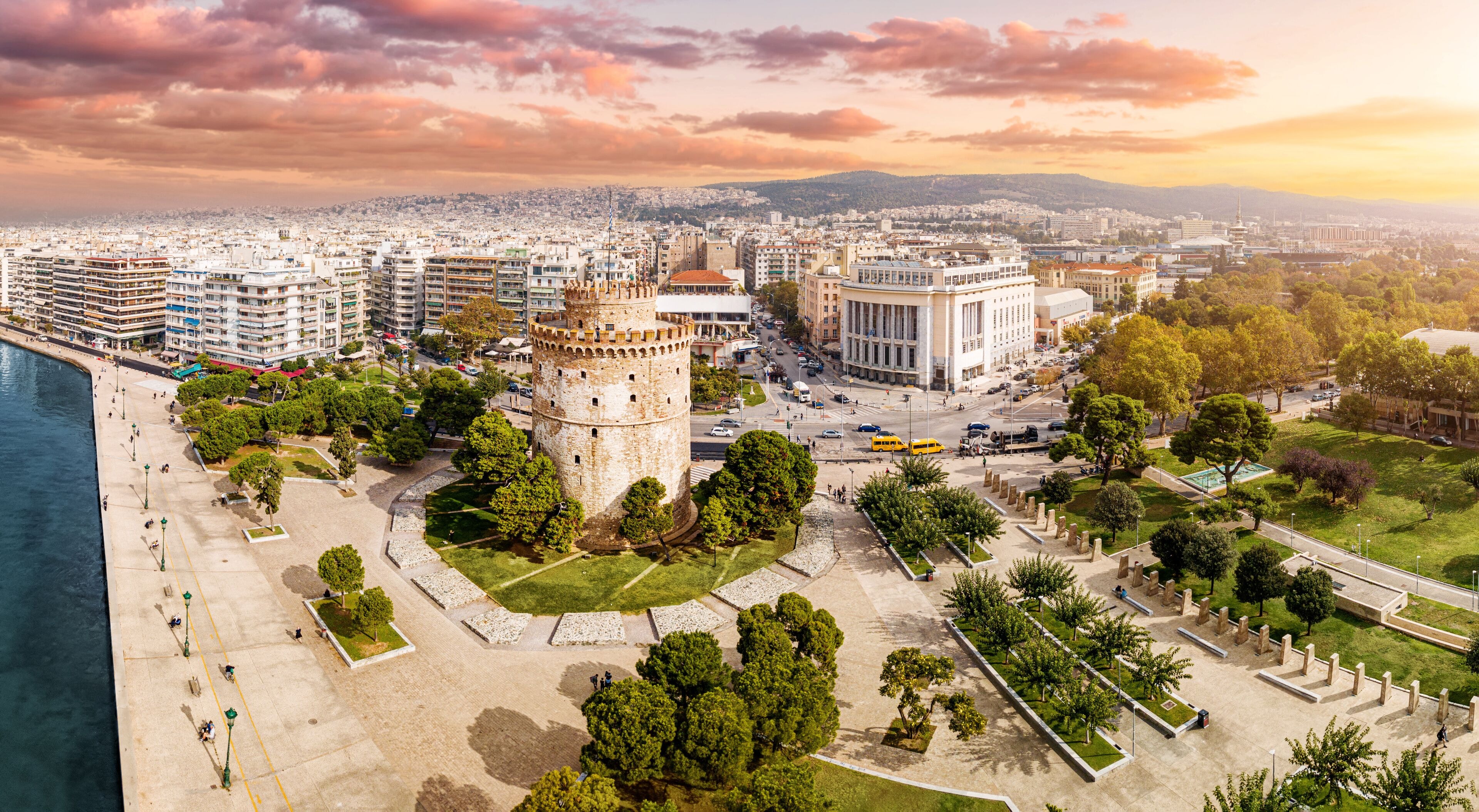
The White Tower (Lefkos Pyrgos) on the waterfront is the city's symbol — a 15th-century Ottoman tower that now houses a museum of Byzantine history. The views from the top over the waterfront and the Thermaic Gulf are extraordinary.
The Byzantine Churches of Thessaloniki are a UNESCO World Heritage Site — a collection of 15 early Christian and Byzantine churches that represent one of the finest concentrations of Byzantine architecture in the world. The Rotunda (originally a Roman mausoleum, later a church, then a mosque) has extraordinary 4th-century mosaics. Agios Dimitrios is the largest church in Greece, built over the crypt where the city's patron saint was martyred.
The Archaeological Museum is one of the finest in Greece, with an extraordinary collection of Macedonian gold — including finds from the royal tombs at Vergina, the burial site of Philip II of Macedon (Alexander the Great's father).
The Ano Poli (Upper City) is the old Ottoman quarter — a maze of traditional houses, Byzantine walls and small churches, with extraordinary views over the city and the gulf.
Food
Thessaloniki has the best food scene in Greece outside Athens — and many Greeks would argue it is better. The city is famous for its bougatsa (custard or cheese pastry), its koulouri (sesame bread rings), its gyros (different from the Athenian version), its seafood and its extraordinary variety of mezedes. The Modiano Market and Kapani Market are the best places to experience the city's food culture.
How to Get There
Thessaloniki has an international airport with flights from the UK and other European cities. It is also served by high-speed train from Athens (around 4 hours).
Best For
Thessaloniki suits travellers who want to experience a real Greek city — those who are interested in Byzantine history and art, who love food and markets, and who want to combine city culture with easy access to Halkidiki and the archaeological sites of northern Greece.
Thinking about Thessaloniki? Talk to us — we can build a northern Greece itinerary that combines the city with Halkidiki, Vergina and the best of Macedonia.

Written by
The Greeko Team
Greeko has been crafting bespoke Greek holidays for over 25 years. Every article is written from genuine first-hand knowledge of the islands, the culture, and the experiences that make Greece extraordinary.


