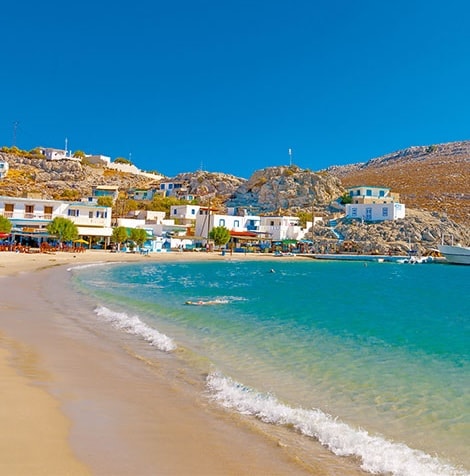
Tilos: The Dodecanese Island That Chose a Different Path
The first island in the Mediterranean to run entirely on renewable energy, a medieval ghost village, extraordinary birdlife and a gentleness that sets it apart from every other island in the Dodecanese.


Tilos made history in 2018 when it became the first island in the Mediterranean to run entirely on renewable energy — a combination of wind and solar power, with battery storage, that has made it energy self-sufficient. It is a fitting achievement for an island that has always done things differently: quieter than its Dodecanese neighbours, gentler in character, and with a natural environment that has been carefully protected.
The Island
Tilos sits between Rhodes and Kos in the Dodecanese, small and hilly, with a coastline of pebble beaches and rocky coves. It has two main settlements: Livadia, the port, and Megalo Chorio, the capital — a beautiful hilltop village with a medieval castle and extraordinary views. A third settlement, Mikro Chorio, was abandoned in the 1950s and stands as a perfectly preserved ghost village on the hillside above Livadia.
Sights and Attractions
Mikro Chorio is one of the most atmospheric places in the Dodecanese — a complete abandoned village of stone houses, a ruined church and narrow lanes, reclaimed by vegetation but still largely intact. The walk up from Livadia takes around 30 minutes.
The Castle of Megalo Chorio dates from the Knights of St John period and contains a small museum with finds from the island's remarkable prehistoric past — Tilos was home to a population of dwarf elephants until around 4,000 BC, and their bones were discovered in a cave in 1971.
The island is an important birdwatching destination — a stopping point on migration routes, with resident populations of Eleonora's falcon, long-legged buzzard and Bonelli's eagle.
Beaches
Tilos's beaches are pebble and shingle rather than sand, and they are uncrowded and excellent. Eristos is the longest and most accessible — a wide bay with clear water and a good taverna. Plaka is wilder and more remote. Agios Antonios is a pretty bay near the northern tip of the island.
Eating and Drinking
Livadia has a handful of excellent tavernas and a relaxed waterfront atmosphere. Joanna's Café is a local institution. The island's food is honest and good — fresh fish, local herbs, excellent olive oil. There is no nightlife to speak of, and no need for any.
Weather
Hot and dry in summer (July–August at 30–33°C), with a reliable sea breeze. The sea is swimmable from May through October. Spring is exceptional — the island is covered in wildflowers and the birdwatching is at its best.
How to Get There
Tilos is served by ferry from Rhodes (around 2.5 hours) and Kos (around 2 hours), with connections to the wider Dodecanese network. It is best combined with Rhodes, Symi or Nisyros.
Best For
Tilos suits nature lovers, birdwatchers, walkers, couples seeking genuine calm, and anyone who wants the Dodecanese without the tourist infrastructure of Rhodes or Kos. It is one of the most peaceful islands in Greece.
Thinking about Tilos? Talk to us — we can combine it with Symi, Nisyros or Rhodes for a Dodecanese itinerary that balances activity with calm.
Written by
The Greeko Team
Greeko has been crafting bespoke Greek holidays for over 25 years. Every article is written from genuine first-hand knowledge of the islands, the culture, and the experiences that make Greece extraordinary.