Leros: The Dodecanese Island That Defies Easy Description
Art Deco architecture from the Italian occupation, a magnificent castle, deep natural harbours and a warmth that regular visitors find impossible to leave behind. Leros is the Dodecanese island that gets under your skin.


Leros is the island that regular visitors to Greece eventually find — and then can't stop returning to. It is not immediately obvious why. The beaches are good but not the best in the Dodecanese. The scenery is beautiful but not dramatic. What Leros has, in abundance, is character: a layered history written in its architecture, a warmth in its people that feels genuine rather than performed, and a pace of life that makes it very easy to stay longer than planned.
The Island
Leros sits in the central Dodecanese, between Patmos and Kos. It is small — 53 square kilometres — and deeply indented, with a coastline of natural harbours and bays that give it an almost landlocked quality in places. The island has five main settlements, each with its own character: Lakki (the main port), Platanos (the capital), Agia Marina, Alinda and Panteli.
The Architecture
Leros was occupied by Italy from 1912 to 1943, and the Italians left an extraordinary architectural legacy. Lakki — built as a model fascist town in the 1930s — is one of the most complete examples of rationalist Art Deco urban planning in the world, with a circular piazza, curved colonnaded buildings and a scale that feels surreal on a small Greek island. It is strange, fascinating and unlike anything else in Greece.
Sights and Attractions
The Byzantine Castle of Panteli dominates the island from its hilltop above Platanos — a massive fortification with extraordinary views across the Dodecanese. The War Museum at Merikia commemorates the 1943 Battle of Leros, one of the bloodiest engagements of the Aegean campaign. The Archaeological Museum in Platanos is small but well-curated.
Beaches
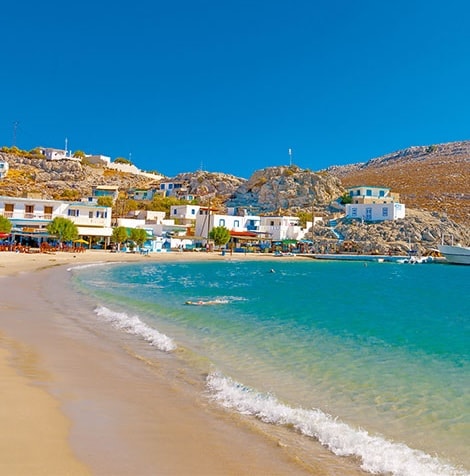
Leros has beaches of every kind. Alinda is the longest — a wide sandy bay with a good range of facilities. Panteli is a pretty fishing village with a pebble beach and excellent tavernas. Blefouti is wilder and more remote. Gourna is sheltered and family-friendly.
Eating and Drinking
Leros has a strong food culture. The tavernas in Panteli and Agia Marina are excellent — fresh fish, grilled octopus, honest mezze. Mylos in Alinda is a favourite for sunset dining. The island's small bars and cafés have a relaxed, local atmosphere that is quite different from the tourist-facing hospitality of the bigger islands.
Weather
Hot and dry in summer (July–August at 30–33°C), with a reliable sea breeze. The sea is swimmable from May through October. Spring and autumn are ideal for exploring on foot.
How to Get There
Leros has a small airport with connections to Athens. Ferries run from Piraeus (Athens) on the main Dodecanese route, stopping at Patmos, Leros, Kos and Rhodes. It is best combined with Patmos, Kalymnos or Kos.
Best For
Leros suits architecture enthusiasts, history lovers, couples who want something genuinely different, and anyone who has been to the Dodecanese before and wants to go deeper. It rewards those who stay at least three nights and explore on foot or by scooter.
Thinking about Leros? Talk to us — we can build it into a Dodecanese itinerary alongside Patmos, Kalymnos and Kos.
Written by
The Greeko Team
Greeko has been crafting bespoke Greek holidays for over 25 years. Every article is written from genuine first-hand knowledge of the islands, the culture, and the experiences that make Greece extraordinary.