

Travel with intention
Greece, handled with care
Greece welcomes over 35 million visitors a year. How we travel matters — for the islands, the communities, and the experiences that make Greece worth visiting at all.
The world's most beloved destination faces its greatest test
Greece is not simply a travel destination. It is a living civilisation — 6,000 islands, 18 UNESCO World Heritage Sites, and communities whose way of life has shaped western culture for three millennia. But the same beauty that draws millions of visitors each year is now under measurable strain.
At Greeko, we believe that extraordinary travel and responsible travel are not in conflict. In fact, the most memorable Greek holidays are almost always the ones that go deeper, move slower, and reach further than the postcard.
The pressure points
When paradise becomes a pressure cooker
The numbers behind Greece's tourism boom are extraordinary. But concentrated in a handful of hotspots, that success creates real consequences for the people who call these islands home.
Water scarcity
Santorini has no natural freshwater source. Every litre is either desalinated at enormous energy cost or shipped in by tanker. Peak summer demand from hotels and visitors pushes the system to its limits, while local residents face restrictions.
Waste under pressure
Mykonos generates more waste per capita during peak season than almost any municipality in Europe. Waste management infrastructure built for 10,000 residents strains visibly under the weight of 1.5 million annual visitors.
Housing affordability
Short-term rental platforms have transformed the housing markets of popular islands. In Santorini, Mykonos, and Rhodes, local families are being priced out of their own communities as landlords convert long-term rentals to tourist accommodation.
Cultural erosion
When visitor numbers dwarf the local population by a factor of 1,000 to one, the authentic character of a place — its tavernas, its rhythms, its language — can be gradually eroded and replaced by a version of itself designed for outsiders.
A different way
The case for slow travel
Slow travel is not about moving less. It's about arriving differently — with curiosity rather than a checklist, with time rather than a tight schedule, and with a genuine interest in the place and its people rather than its Instagram coordinates.
Go in shoulder season
April, May, September and October offer the same light, the same sea, and the same food — with a fraction of the crowds. Prices drop, locals have time to talk, and the experience is simply better.
Stay longer, go fewer places
A week on one island is worth more than three days each on three. You find the beach that isn't on any map. You become a regular at the same taverna. You understand a place rather than photograph it.
Disperse beyond the hotspots
For every Santorini, there is a Sifnos. For every Mykonos, there is a Folegandros. Greece's lesser-known islands offer experiences that are richer, more authentic, and actively need the economic benefit that thoughtful visitors bring.
Spend locally
Choose family-run guesthouses over international chains. Eat at the taverna where the owner's mother cooks. Buy olive oil from the producer, not the airport. Every euro spent locally stays in the community.
Islands leading the way
Greece's sustainability pioneers
While the headlines focus on overtourism, a quieter revolution is underway on some of Greece's smaller islands — proving that tourism and sustainability are not just compatible, but mutually reinforcing.
Plastic-Free Paros
Paros has become one of the Mediterranean's most ambitious zero-waste projects. The island's Plastic Free Paros initiative has mobilised businesses, residents, and visitors to eliminate single-use plastics entirely — replacing them with reusable, compostable, and locally sourced alternatives. The programme has inspired similar movements across the Cyclades.
Electric Astypalaia
In partnership with Volkswagen Group and the Greek government, Astypalaia is replacing every internal combustion vehicle on the island with electric cars, scooters, and bicycles. A smart public transport app coordinates shared mobility across the island's 1,300 residents. Astypalaia is now a global reference point for island electrification.
Tilos: Europe's first energy-autonomous island
Tilos became the first island in the Mediterranean to achieve full energy independence through a hybrid wind and solar system with battery storage. The TILOS project, funded by the EU's Horizon 2020 programme, has eliminated the island's dependence on diesel generators and provided a replicable model for remote island communities worldwide.
Official commitment
Greece's national sustainability pledge
The Greek National Tourism Organisation (GNTO) has placed sustainability at the core of its strategy — not as a marketing position, but as an operational commitment. The GNTO actively advocates for partnerships with enterprises that demonstrate alignment with Environmental, Social, and Governance (ESG) criteria and the UN Sustainable Development Goals. When curating proposals for international events and tourism development, the GNTO champions venues, hotels, and suppliers that invest in green infrastructure, reduce their carbon footprint, and support local communities.
By choosing Greece, you are collaborating with a network of professionals dedicated to ethical practices and environmental stewardship. Together, we can design world-class experiences that honour our heritage and protect our planet for generations to come.
The Greeko approach
How we travel differently
Responsible tourism is not a constraint on great travel — it's the foundation of it. Our commitment to sustainability shapes every recommendation we make, every partner we work with, and every itinerary we build.
We champion the lesser-known
Our destination recommendations actively steer travellers toward islands and regions that benefit from visitor spending without being overwhelmed by it. We believe the best Greek holiday is rarely the most obvious one.
We advocate for shoulder season
We actively encourage travel in April, May, September, and October — shoulder months when Greece is at its most beautiful, most affordable, and most authentic. The experience is better. The impact is lighter.
We partner with purpose
Every accommodation partner in our collection is selected not just for quality, but for their relationship with their local community and environment. We prioritise family-run properties, locally sourced food, and operators with genuine sustainability credentials.
We support eco-certification
We actively promote hotels and operators working toward EU Ecolabel, Green Key, and Travelife certification — and we are transparent with our travellers about which partners hold these credentials.
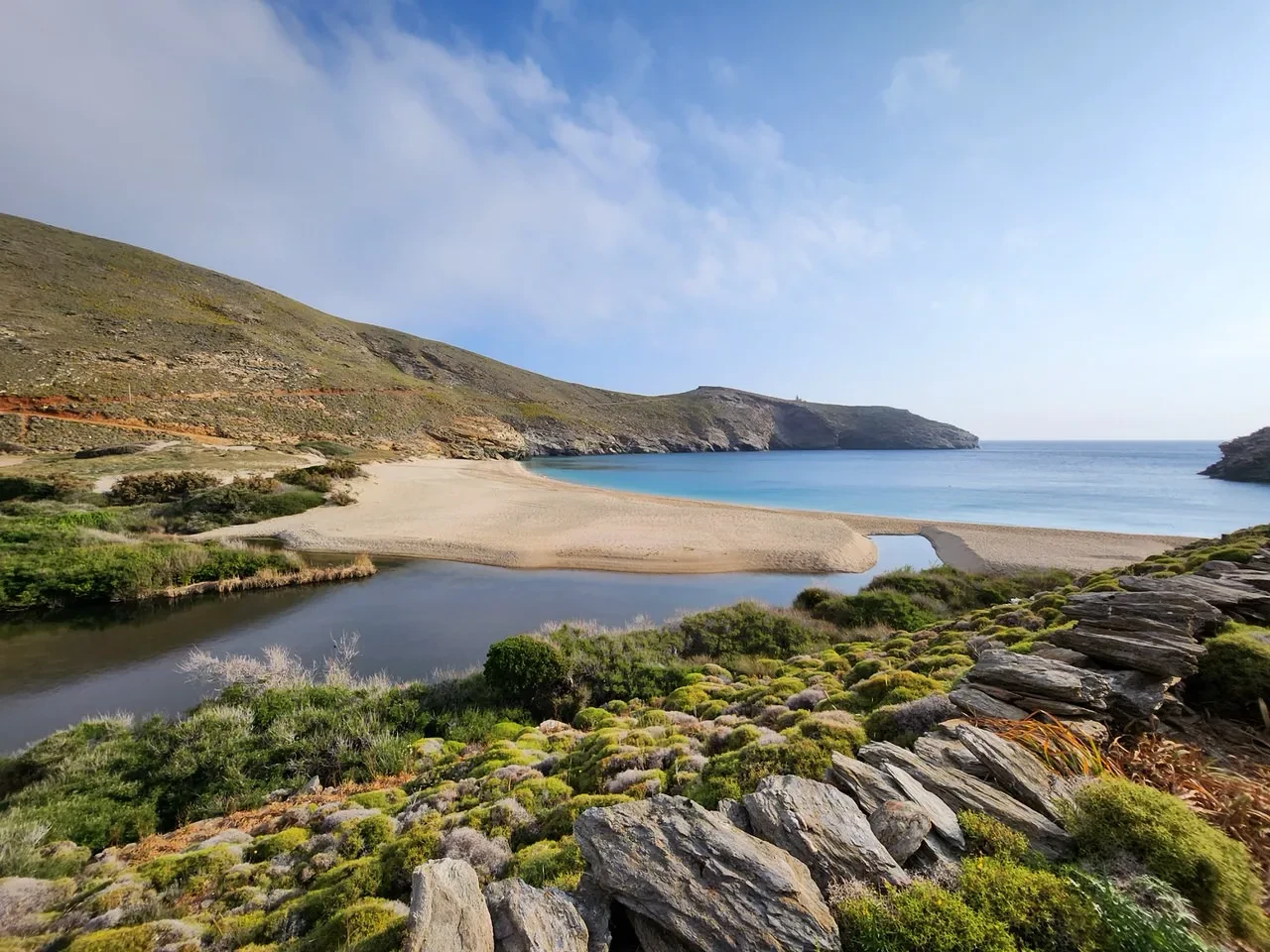
Greeko + Andros
Travel here. Support here. Protect here.
Greeko Gives Back
Every Greek holiday should leave something good behind.
Responsible tourism is not just a philosophy — it needs to be funded. That's why 7.5% of Greeko's net booking revenue is reinvested directly into the communities, environments and cultures that make Greece worth visiting in the first place.
Travel that gives back
The best Greek holiday you will ever take is one that leaves the islands better than you found them. Let us help you plan it.